The Best Fluffy Pancakes recipe you will fall in love with. Full of tips and tricks to help you make the best pancakes.


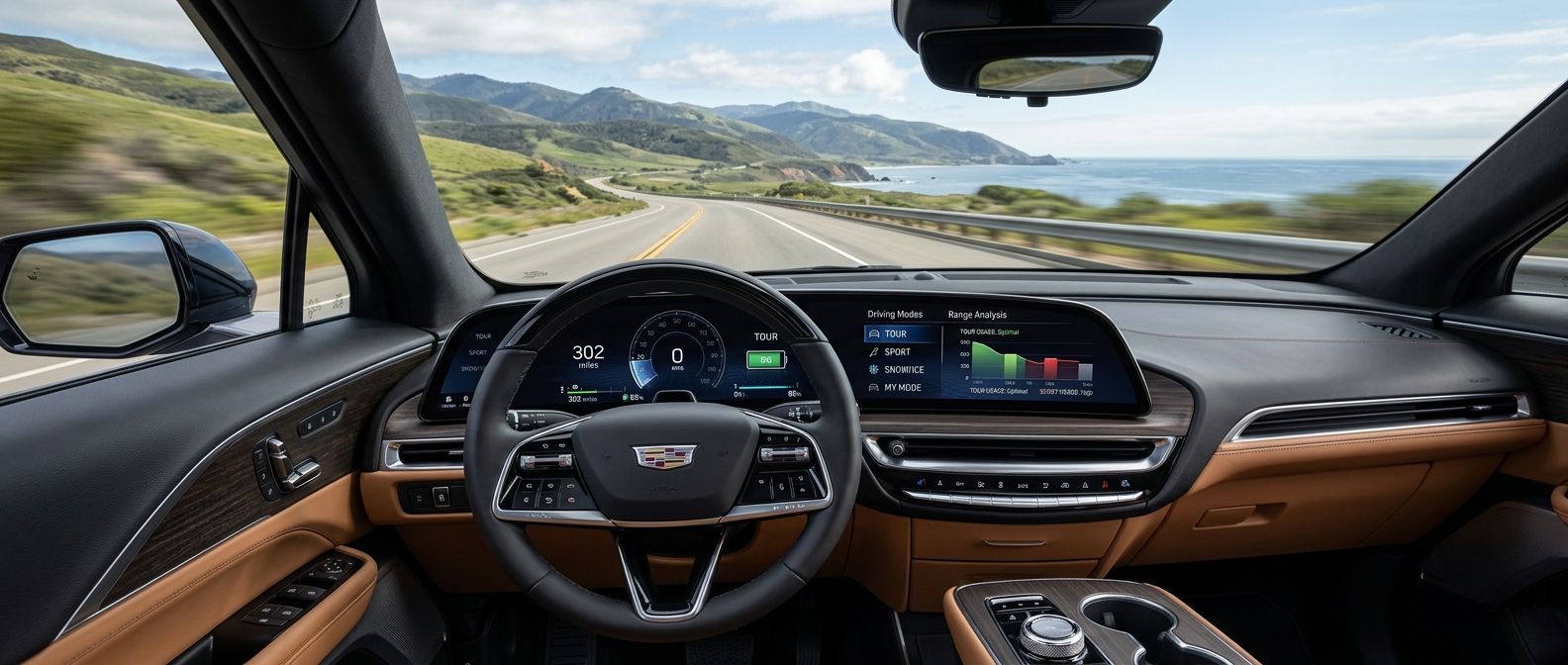
The short answer is yes. The longer answer is more interesting.
The Cadillac LYRIQ’s driving modes don’t change the battery. The 102 kWh Ultium pack is the same hardware in every mode. What changes is the software governing how quickly that battery gets used – the throttle mapping, the torque delivery curve, the regenerative braking strength, and the traction control logic. Those calibrations add up. Owner data and real-world testing suggest the difference between Tour Mode and aggressive Sport Mode driving can swing range by 20 to 70 miles on a full charge. That’s not trivial. It’s the difference between arriving at your destination comfortably and hunting for a charger.
Here is the complete breakdown of every mode, what it actually does, and how to use them intelligently.
The LYRIQ’s Battery and Range Baseline
Before getting to modes, the foundation matters. Every 2025 and 2026 Cadillac LYRIQ uses a 102 kWh rated Ultium battery platform. According to the official 2026 LYRIQ specifications on Cadillac.com, the EPA-estimated range figures are:
- Single-motor RWD: 326 miles
- Dual-motor AWD (standard 11.5 kW charging): 319 miles
- Dual-motor AWD (available 19.2 kW charging): 303 miles
- LYRIQ-V: 285 miles (EPA-estimated)
These are standardized laboratory figures derived from controlled test cycles in default Tour Mode with climate control minimized. They’re useful benchmarks for comparison but don’t represent what you’ll see on the road under real conditions.
Consumer Reports’ independent road test of the LYRIQ AWD achieved 315 miles in a 70 mph highway range test. Edmunds tested the 2025 LYRIQ and recorded 319 miles of real-world range on their track – notably matching the EPA figure, which is unusual and reflects well on the LYRIQ’s efficiency calibration at moderate speeds. Car and Driver’s highway test of the AWD version at sustained 75 mph recorded 220 miles – significantly lower, illustrating how speed alone collapses range faster than any driving mode change.
The takeaway before modes enter the conversation: battery size is fixed, EPA figures assume efficiency-optimized conditions, and speed is the single biggest variable. Mode selection sits below speed in the hierarchy of range impacts – but it’s still meaningful.
Tour Mode: The Baseline
Tour Mode is the default. Every time you start the LYRIQ it resets to Tour Mode. That default isn’t arbitrary – it’s the calibration Cadillac and the EPA use as the efficiency reference point.
In Tour Mode, throttle mapping is linear and progressive. The relationship between pedal position and motor torque output is smoothed deliberately. A given pedal input commands a proportional, measured torque response – not an aggressive one. This keeps instantaneous power draw controlled and battery discharge rates consistent, which is why Tour Mode aligns most closely with EPA-tested range conditions.
Suspension, steering, and damper settings in Tour Mode prioritize comfort and balance. The ride is fluid. Regenerative braking operates at a standard recovery rate. The whole system is optimized for the pattern that maximizes range: moderate acceleration, smooth deceleration, consistent speed.
For daily driving – commuting, errands, highway cruising at reasonable speeds – Tour Mode is the setting that gives you the most range per charge. Owner reports consistently show Tour Mode delivering efficiency figures close to EPA estimates, sometimes exceeding them in mixed driving with good regen use.
Sport Mode: More Performance, Less Range
Sport Mode changes the throttle map fundamentally. Where Tour Mode smooths the pedal-to-torque relationship, Sport Mode sharpens it. A smaller pedal input commands a larger, more immediate torque response. The car feels decisively quicker, particularly in the 0-40 mph range where most city driving happens.
The trade-off is energy. When the electric motors are asked to deliver torque faster and more aggressively, instantaneous kilowatt draw increases. Each acceleration event pulls more current from the battery than the equivalent maneuver in Tour Mode. Steering weight increases. Suspension and damper settings firm up. The LYRIQ becomes a more engaging driving experience – and a less efficient one.
The range penalty from Sport Mode is behavioral more than mechanical. The mode itself doesn’t drain the battery at rest or at constant speed. What it does is make aggressive driving feel natural, which means most drivers in Sport Mode use more aggressive inputs than they would in Tour Mode. The combination of sharper throttle response and the driver behavior it encourages can reduce range by 10 to 20 percent compared to equivalent Tour Mode driving. On a 326-mile RWD LYRIQ, that’s 30 to 65 miles of range.
Sport Mode is well-suited for short drives where performance is the priority. It’s not the right setting for a road trip where range management matters.
Snow/Ice Mode: Safety First, Moderate Efficiency
Snow/Ice Mode is the traction specialist. It softens throttle response below Tour Mode levels – the opposite direction from Sport – to prevent wheel spin on low-grip surfaces. Traction control thresholds tighten. On AWD models, torque distribution between front and rear motors adjusts for stability. Steering response moderates.
The efficiency story in Snow/Ice Mode is nuanced. On a dry road, the softer throttle mapping actually produces slightly better efficiency than Tour Mode, because it further reduces aggressive acceleration events. On a slippery road – the actual use case – wheel spin that wastes energy without generating forward motion is prevented, which has a net positive effect on efficiency compared to driving Tour Mode in slippery conditions. Cold weather itself reduces battery range (typically 10 to 30 percent in sub-freezing temperatures), and Snow/Ice Mode doesn’t fix that – no driving mode does. But it prevents the additional waste from traction loss.
The practical summary: use Snow/Ice Mode when conditions call for it. The efficiency impact is neutral to mildly positive compared to Tour Mode, and the safety benefit is significant.
My Mode: What You Make It
My Mode is the customizable setting. Through the 33-inch infotainment display, drivers can independently adjust acceleration feel (from relaxed to sport), steering effort (light to heavy), suspension tuning (comfort to sport), and regenerative braking behavior (standard to stronger). A My Mode profile can be saved and recalled.
The range implications of My Mode depend entirely on how it’s configured. A My Mode set to relaxed acceleration, light steering, comfort suspension, and maximum regeneration will outperform Tour Mode in efficiency. A My Mode set to sport acceleration and minimal regeneration will behave like Sport Mode. The mode itself is a container – the settings inside determine the outcome.
For efficiency-focused drivers, My Mode is where meaningful personalization lives. Setting regenerative braking to maximum and pairing it with relaxed throttle response creates an efficiency profile that Tour Mode doesn’t fully replicate. For drivers who want Sport Mode steering without Sport Mode throttle, My Mode delivers that split as well. Consumer Reports’ detailed LYRIQ road test noted the customizability of the LYRIQ’s drive systems as one of its standout features for matching the car’s behavior to individual driving preferences.
Velocity Max (LYRIQ-V Only): Maximum Performance, Maximum Draw
The LYRIQ-V adds Velocity Max mode and V-Mode, available only on this performance variant. The LYRIQ-V makes 615 horsepower and 650 lb-ft of torque in Velocity Max, and reaches 0-60 mph in 3.3 seconds. The EPA-estimated range for the LYRIQ-V is 285 miles – already lower than the standard LYRIQ due to the higher-output dual motor configuration. Engaging Velocity Max further reduces that figure substantially.
These modes exist for performance driving – track days, spirited canyon roads, demonstrating the vehicle’s full capability. They are not range-efficient in any context and are not designed to be. The LYRIQ-V is a different product from the standard LYRIQ in this respect: it trades efficiency headroom for performance ceiling.
Regenerative Braking: The Range Variable That Cuts Across All Modes
Independent of driving mode, the LYRIQ’s Regen on Demand paddle on the steering wheel allows manual control of regenerative braking intensity at any moment. Pulling the paddle increases regenerative braking – the motors reverse function and act as generators, converting kinetic energy back into battery charge during deceleration.
One-Pedal Driving, toggled through the infotainment system, allows the accelerator alone to control both acceleration and deceleration. Releasing the pedal applies regenerative braking automatically. In city driving with frequent stops – the environment where EVs typically outperform their highway range estimates – maximizing regen recovery through the paddle or One-Pedal Driving has a more significant impact on range than mode selection alone.
The combination of Tour Mode plus active Regen on Demand use represents the most efficient operating profile available in the LYRIQ. Owner reports on Cadillac owner forums suggest this combination can extend range by 10 to 15 percent above Tour Mode baseline in city and mixed driving conditions.
What Actually Affects Range More Than Modes
Driving modes matter. But several variables matter more, and understanding the hierarchy helps calibrate expectations accurately.
Speed is the dominant variable. Physics dictates that aerodynamic drag increases with the square of velocity. At 75 mph the LYRIQ uses substantially more energy per mile than at 65 mph – Car and Driver’s 220-mile AWD result at sustained 75 mph versus the 307-mile EPA figure is the data that makes this concrete. No driving mode closes that gap. Slowing down on a long highway drive does more for range than switching from Sport to Tour.
Temperature is significant. Cold weather reduces battery capacity and increases energy demand for cabin heating. Below 20 degrees Fahrenheit, range can fall 20 to 30 percent regardless of mode. The LYRIQ’s thermal management system works to mitigate this, but chemistry limits apply. Pre-conditioning the battery and cabin while plugged in before departure minimizes this impact.
Wheel size affects range more than most owners expect. Owner survey data cited in testing reports found that larger 22-inch wheels cause 3 to 5 percent lower efficiency compared to smaller 19 or 20-inch wheels due to increased rolling resistance and weight. On a 326-mile LYRIQ, that’s up to 16 miles of range lost to wheel choice alone – comparable to the penalty from Sport Mode light use.
HVAC is meaningful. Running the heat on a cold day draws continuous power from the battery. Running the air conditioning in summer is less demanding but still measurable. Pre-conditioning while plugged in – using grid power to heat or cool the cabin before departure – preserves battery range for the drive itself.
The Practical Summary
Tour Mode for everyday driving, range maximization, and road trips. My Mode configured for maximum regen and relaxed acceleration if you want to push efficiency further. Sport Mode for short drives where performance is the priority. Snow/Ice Mode whenever traction conditions call for it. Velocity Max on the LYRIQ-V for performance driving where range is not the priority.
The modes create a real, measurable range difference of 20 to 70 miles on a full charge between the most and least efficient settings under similar conditions. That’s not a small number. For a vehicle with 300-plus miles of range, it’s roughly a 7 to 22 percent swing that is entirely within the driver’s control.
For more on the technology driving the EV segment and the platforms shaping how cars get built and driven, the Tech category at masago.blog has broader coverage. For everything across the site, the masago.blog homepage has the full range.
Small things. Big flavor.
FAQs
Do the driving modes in the Cadillac LYRIQ affect range?
Yes. Driving modes change how quickly the LYRIQ draws energy from its fixed 102 kWh battery by adjusting throttle mapping, torque delivery, and regenerative braking behavior. The difference between Tour Mode and aggressive Sport Mode driving can reduce range by 20 to 70 miles on a full charge. The battery capacity itself does not change.
What is the most efficient driving mode in the Cadillac LYRIQ?
Tour Mode is the baseline efficiency setting. My Mode configured with relaxed acceleration and maximum regenerative braking can outperform Tour Mode in city and mixed driving. Pairing either mode with active Regen on Demand paddle use extends range further.
What does Sport Mode do to LYRIQ range?
Sport Mode sharpens throttle response and torque delivery, which encourages higher instantaneous power draw. In practice, Sport Mode reduces range by approximately 10 to 20 percent compared to Tour Mode driving. On a 326-mile RWD LYRIQ that’s roughly 30 to 65 fewer miles. Sport Mode is suited to short performance-focused drives, not range-critical trips.
What is Snow/Ice Mode on the Cadillac LYRIQ?
Snow/Ice Mode softens throttle response and adjusts traction control to prevent wheel spin on low-grip surfaces. It’s designed for safety in slippery conditions. Its efficiency impact is neutral to mildly positive compared to Tour Mode – the softer throttle reduces aggressive acceleration events, and preventing wheel spin avoids energy waste on slippery roads.
What is My Mode on the Cadillac LYRIQ?
My Mode is a customizable driving profile adjusted through the 33-inch infotainment display. Drivers can independently set acceleration feel, steering effort, suspension tuning, and regenerative braking behavior. Range impact depends entirely on how it’s configured – an efficiency-focused My Mode can outperform Tour Mode, while a performance-focused My Mode behaves like Sport Mode.
What is Velocity Max on the Cadillac LYRIQ?
Velocity Max is exclusive to the LYRIQ-V performance variant, which makes 615 horsepower and reaches 0-60 mph in 3.3 seconds. The LYRIQ-V has an EPA-estimated range of 285 miles. Engaging Velocity Max further reduces range substantially. It is designed for performance driving, not efficiency.
Does the LYRIQ drivetrain (RWD vs AWD) affect range more than driving modes?
In most real-world scenarios, yes. The RWD LYRIQ is EPA-estimated at 326 miles and the AWD at 303 to 319 miles depending on charger configuration. That 7 to 23 mile difference is a hardware-level distinction that driving modes cannot close. High speed, cold weather, and wheel size also affect range more significantly than mode selection alone.
What is the real-world range of the Cadillac LYRIQ?
Independent testing results vary by conditions. Edmunds recorded 319 miles tested range on the AWD model. Consumer Reports’ AWD highway test at 70 mph achieved 315 miles. Car and Driver’s sustained 75 mph highway test of the AWD recorded 220 miles. In mixed city and highway driving, most owners report 270 to 310 miles depending on conditions and driving behavior.