The Best Fluffy Pancakes recipe you will fall in love with. Full of tips and tricks to help you make the best pancakes.


Gunkan solved a problem that nigiri couldn’t.
Before 1941, certain ingredients had no place on a sushi menu. Sea urchin, salmon roe, natto, finely chopped fish – anything soft, loose, or wet that wouldn’t stay put on a hand-pressed rice mound simply wasn’t served as sushi. The form didn’t exist to hold them. Gunkan is what changed that. It’s a small thing, structurally. The implications were not small.
What Gunkan Actually Is
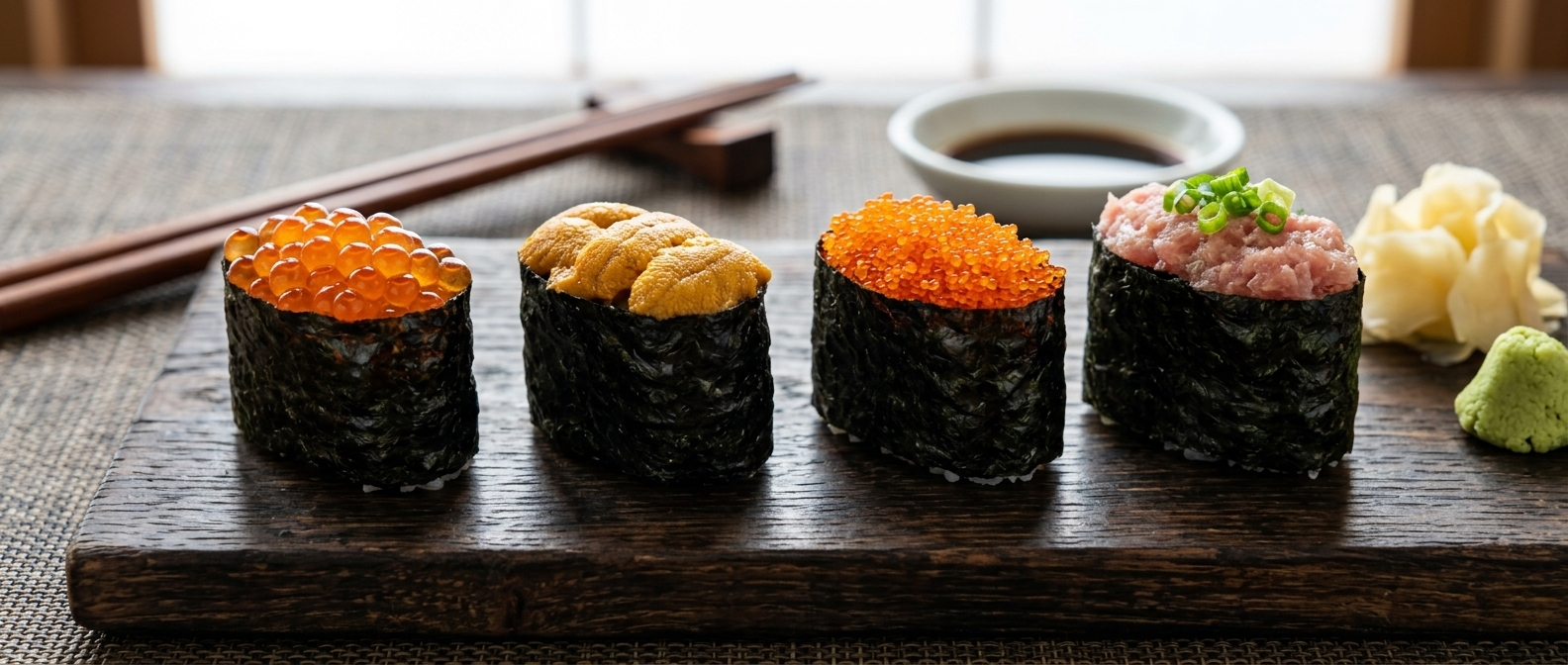
Gunkan (軍艦) is a Japanese word meaning warship or battleship. The name describes the shape exactly: a compact oval of hand-pressed sushi rice with a strip of nori wrapped vertically around its perimeter, rising about a centimeter above the rice to create a small edible vessel. The nori wall is the innovation. It turns the rice into a container, which means anything that can be spooned or piled into a shallow bowl can now become sushi.
The structure is technically a form of nigirizushi – hand-pressed rice – but with the nori acting as a retaining wall rather than a simple band. Just One Cookbook’s Ultimate Sushi Guide, the most comprehensive English-language reference on Japanese sushi types, describes gunkan as a form of nigirizushi where the rice is wrapped in a thin band of nori and topped with various ingredients – with typical toppings including tobiko, ikura, and uni.
That last trio is not coincidental. All three are loose, wet, and impossible to drape over standard nigiri rice. Gunkan exists because of ingredients like those.
The Origin Story
The specific origin of gunkan is unusually well documented for a sushi form, and Sushi University’s blog – a professional Japanese sushi resource drawing directly on chef accounts – records it with named people and a specific incident.
The restaurant is Ginza Kyubey, one of the most storied sushi restaurants in Tokyo, established in 1932. The chef is Hisaji Imada. The year is 1941.
One evening, a regular customer – the kind of person who ate at Kyubey frequently enough to make unusual requests – told Imada he was tired of ordinary sushi and that ikura, salmon roe, sounded like it would make good sushi. It was said partly as a joke. Imada took it seriously.
The problem was immediately obvious: roe would roll off shari (sushi rice) instantly. There was no way to serve it as nigiri. Imada thought about it that night and arrived at the solution – surround the rice with nori, tall enough to contain what goes on top of it. He served it to the customer on his next visit. The response was considerably better than expected.
That moment at Kyubey is when gunkan was born. Within years, the form had spread through high-end sushi restaurants across Japan and eventually became standard globally. The invention significantly expanded the range of ingredients that could be served as sushi – a practical impact that is hard to overstate.
What Goes In Gunkan
The range is wider than most people expect. The classic toppings are the ones that defined the form’s necessity: ikura (salmon roe), uni (sea urchin), and tobiko (flying fish roe). All three are loose, briny, and texturally distinctive in a way that would be entirely lost if they had to be adapted into a roll or smeared onto standard nigiri. Gunkan serves them as they should be – piled generously, visually striking, eaten in a single bite.
Masago – the small orange capelin roe that masago.blog is named after – is one of the most common gunkan toppings across sushi restaurants worldwide. Our full guide to what masago actually is covers where it comes from, how it tastes, and what distinguishes it from the other roe types you’ll encounter in this format. The masago vs tobiko comparison is worth reading alongside it – tobiko and masago are the two roe types most frequently confused, and gunkan is where that confusion most often happens because both appear as toppings on identical structures.
Beyond roe, negitoro is one of the most popular gunkan variants in Japan. Negitoro is finely minced fatty tuna – the meat scraped from near the bones and skin – mixed with green onion. The name is commonly assumed to combine “negi” (green onion) and “toro” (fatty tuna), but the actual etymology of “negi” here refers to the verb negitoru, meaning to scrape off. It’s one of the most prized inexpensive preparations in sushi because it uses parts of the tuna that can’t be served as clean slices.
Other standard gunkan toppings include natto (fermented soybeans, which are polarizing enough to have their own strong following), corn with Japanese mayonnaise (common in kaiten sushi chains and unexpectedly popular), quail egg, oysters, scallops, and seasoned sea cucumber. At more creative restaurants, the form has been extended into wagyu beef tartare, mushroom preparations with cream, and variations that use cucumber strips or thin-sliced smoked salmon in place of nori for the outer wall – a departure from tradition that works visually and texturally.
Gunkan vs Nigiri vs Maki: Where It Actually Fits
The taxonomy question comes up because gunkan sits awkwardly between categories. It’s hand-formed like nigiri, but the nori is structural rather than decorative. It’s not rolled like maki. Some sushi masters classify it as a nigiri variant. Others treat it as its own category. There’s no settled consensus in the professional sushi world, which is unusual for a form with an 80-year history.
The practical distinction is simpler: nigiri holds toppings that can be sliced and draped. Maki holds fillings that are rolled. Gunkan holds toppings that are neither – the soft, loose, wet, or finely chopped preparations that require containment. That functional definition is what actually separates it from the other forms, regardless of where taxonomists land.
How to Eat Gunkan
Gunkan presents a small but real practical challenge that nigiri and maki don’t. The roe or other toppings sitting in the nori vessel are not easy to dip in soy sauce. The standard approach – using a piece of pickled ginger as a brush, dipping the ginger in soy sauce and then dabbing it lightly onto the topping – is the traditional method and genuinely works better than trying to turn the whole piece upside down over a soy sauce dish.
At omakase restaurants, the chef typically adds soy sauce directly to the gunkan before serving it. In that context, do not add additional soy sauce yourself. The chef has already seasoned it, and doubling up makes the topping taste like nothing but salt.
Gunkan should always be eaten immediately after it’s served. The nori starts to absorb moisture from the rice and toppings within minutes, softening from crisp to chewy. A soft nori wall changes the entire eating experience – the crunch is part of the texture contrast the form is built on. At kaiten sushi (conveyor belt) restaurants, this is one of the reasons gunkan sitting on the belt for too long should be avoided. Fresh off the line only.
Gunkan at Home
Making gunkan at home is genuinely approachable – it’s one of the more forgiving sushi forms for home cooks because the nori wall compensates for imperfect rice shaping. You need properly seasoned sushi rice (our sushi rice vs white rice breakdown covers the preparation and seasoning ratios), nori cut into strips approximately 3 to 3.5 centimeters tall and long enough to wrap the rice oval with slight overlap, and whatever topping you want to work with.
The rice is shaped into a compact oval – about 25 grams, roughly the size of a small egg – by pressing lightly in your palm. The nori strip wraps around the perimeter and seals at the overlap using a single grain of rice as adhesive. The topping goes in last, spooned or piled generously above the nori line. The whole assembly takes under a minute once the rice is prepared.
The critical variable is rice temperature. Room temperature sushi rice holds its shape and accepts the nori correctly. Cold rice from the fridge is too dense and dry. Hot rice steams the nori and softens it immediately. Make the rice, season it, let it come to room temperature, and work from there.
For more on the roe toppings most commonly used in gunkan, our guide to masago in sushi covers how these small fish eggs are used across sushi preparations. If you want to understand what the calorie picture looks like for a typical gunkan order alongside the rest of your meal, the sushi calories breakdown covers every sushi format including roe toppings. And if the raw vs cooked question came up while reading this, is sushi raw fish has the full answer on what’s raw and what isn’t across a standard sushi menu.
For more Art & Culture and Eat & Drink coverage, the full range is at the masago.blog homepage.
Small things. Big flavor.
FAQs
What is gunkan sushi?
Gunkan is a type of sushi made from a hand-pressed oval of sushi rice wrapped with a vertical strip of nori that rises above the rice to create a small vessel. The nori wall holds soft, loose, or wet toppings – typically fish roe, sea urchin, or finely minced fish – that can’t be served on standard nigiri. The name means warship or battleship in Japanese, a reference to the shape.
Where was gunkan invented?
At Ginza Kyubey restaurant in Tokyo in 1941. Chef Hisaji Imada invented the form in response to a regular customer’s request for salmon roe as sushi. The problem was that roe rolls off nigiri rice immediately. Imada solved it by wrapping the rice in a nori strip tall enough to contain the topping.
What is the difference between gunkan and nigiri?
Nigiri is hand-pressed rice with a topping that can be sliced and draped directly over it – fish, egg, shrimp. Gunkan uses the same hand-pressed rice base but adds a nori wall that functions as a container for toppings too soft or loose to stay on nigiri: roe, sea urchin, minced fish, natto. The nori in nigiri, when used, is purely decorative. The nori in gunkan is structural.
What toppings go on gunkan?
The classic toppings are ikura (salmon roe), uni (sea urchin), tobiko (flying fish roe), and masago (capelin roe). Negitoro (minced fatty tuna with green onion) is one of the most popular non-roe varieties. Other common options include natto, corn with Japanese mayonnaise, quail egg, scallops, and oysters. At creative restaurants, wagyu tartare and mushroom preparations are also served in gunkan form.
Is gunkan maki the same as gunkan?
Yes. Gunkan maki (軍艦巻き) and gunkan sushi (軍艦寿司) both refer to the same preparation. Maki means roll or wrap in Japanese, which led to the maki designation even though gunkan isn’t technically rolled in the traditional makizushi sense. Both terms are used interchangeably in Japanese and English.
How do you eat gunkan properly?
Use a piece of pickled ginger as a brush – dip the ginger in soy sauce and dab lightly onto the topping. Don’t try to flip gunkan upside down into soy sauce; it will fall apart. At omakase restaurants, the chef usually seasons it before serving – no additional soy sauce is needed. Always eat gunkan immediately after it’s served, as the nori softens quickly from moisture contact.
Can you make gunkan at home?
Yes, and it’s one of the more forgiving sushi forms for home cooks. You need seasoned sushi rice shaped into 25-gram ovals, nori cut into strips about 3 to 3.5 centimeters tall, and your chosen topping. The nori wraps around the rice and seals with a grain of rice at the overlap. Work with room-temperature rice – cold rice is too dense, hot rice softens the nori immediately.
Why does gunkan need to be eaten immediately?
The nori begins absorbing moisture from the rice and toppings within minutes of assembly. A fresh gunkan has a crisp nori wall that provides textural contrast to the soft rice and topping. A gunkan that has sat for ten minutes has a soft, chewy nori wall that changes the eating experience significantly. This is why gunkan isn’t ideal for delivery orders or lunchboxes.